Patented technology for HFO tank heating
Stop heating the whole tank
EFH heats only the fuel volume you are about to transfer, instead of holding the entire tank warm around the clock. Lower steam demand, less boiler fuel, measurable CO2 reduction.
Patented technology owned by Englan AS
Low tech. No new automation to maintain
High ROI, paid for out of boiler fuel
Energy optimization on demand, not 24 hours a day
Why it matters
Continuous tank heating is the last unexamined energy loss on board
Traditional HFO systems hold entire bunker and settling tanks warm around the clock so the oil stays pumpable. Every hour the oil sits above the temperature around it, energy leaves through steel, through the hull and into the sea.
Cut the heat loss at its source
Heat loss grows with the temperature difference between the oil and everything around the tank. By letting the bulk of the tank sit close to ambient, EFH removes the driving force behind the loss instead of insulating against it.
Free up steam and boiler capacity
Less steam sent to tank coils means less boiler firing, and more headroom for the systems that actually need it. That matters most in slow steaming and low load operation, where economizer steam alone often cannot keep up.
Lower fuel cost and CO2 together
Every tonne of boiler fuel avoided is a tonne not paid for and roughly 3.1 tonnes of CO2 not emitted. Energy previously written off as unavoidable becomes a measurable commercial gain.
Same tank, same fuel, a completely different heating strategy
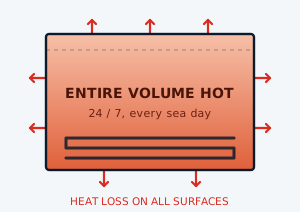
Traditional bulk heating
The whole tank is the heater
Steam runs to coils covering the tank floor and the full oil volume is held warm continuously, so the oil stays pumpable whenever it is needed. Heat escapes through every wetted surface, every hour of the voyage.
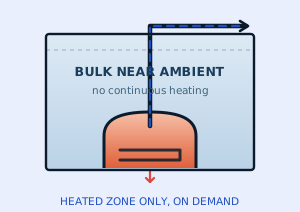
EFH, Efficient Fuel Heating
A convection shield does the work
Heating coils sit inside a shield that traps the warm oil and keeps it separated from the cold oil around it. Suction is taken from the top, inside the shield. When the oil reaches temperature the pump starts. When transfer ends, so does the heating.
Diagrams are simplified for explanation. Actual savings depend on tank geometry, insulation, trade pattern, fuel grade and the existing heating arrangement, and should be established per vessel.
From first assessment to verified result
We are not only selling hardware. The commercial case has to be built on your vessel own numbers, so measurement is part of the work rather than an afterthought.
Vessel assessment and ROI modelling
We review tank arrangement, heating layout, steam balance and operating profile to establish where the energy is actually going. That becomes a transparent model of steam demand, boiler fuel, CO2 exposure and payback, built on your data with every assumption visible and open to challenge.
Engineering and installation
Prefabricated steel sections designed around your tank, sized to pass through existing access and delivered for assembly at yard or during a planned stay.
Pilot measurement
Steam, condensate, boiler and fuel data captured before and after installation, so the saving ends up documented rather than claimed.

A simple idea, engineered by people who have worked the ships
Englan Fuel Heating was formed to develop and commercialise EFH, a patented approach that came out of a straightforward observation: almost all the energy spent keeping a bunker tank warm is spent on oil nobody is about to move.
We deliberately kept the solution mechanical. No new control philosophy, no software layer to maintain, nothing that has to be understood at three in the morning in heavy weather. The engineering effort went into the shield geometry and the convection behaviour, the parts that decide whether it actually works.
Tell us about one ship and we will tell you what the heating is costing you
Send the tank arrangement and a rough operating profile. We come back with an honest view of whether EFH makes commercial sense for that vessel, including when it does not.